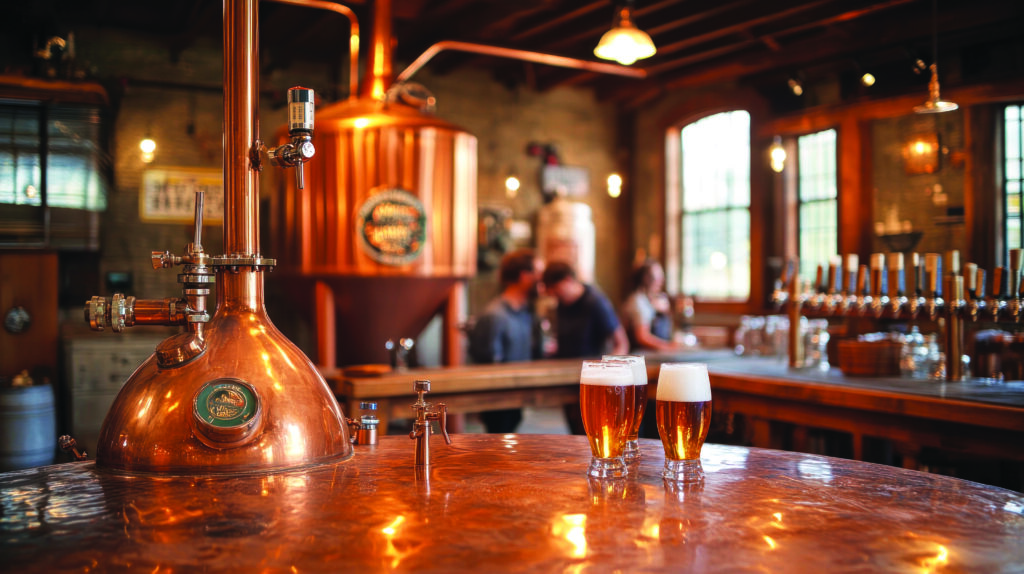
Adding a tasting area to a craft brewery is a popular way to create an additional revenue stream and expose a new group of customers to your product. However, it can present challenges when it comes to planning the space and getting approval from your local building department. Here Adam Gillies, Technical Consultant at LRI Engineering Inc., outlines what to look out for.
The building code classifies different spaces according to their use, or occupancy, such as residential, office, assembly, industrial and retail. Each occupancy typically has unique fire and life safety requirements associated with it.
There are also requirements related to how occupancies can be combined within a building. For example, certain occupancies are not even permitted to be located in the same building.
Under the building code, breweries are typically considered industrial occupancies, while tasting areas are typically considered assembly occupancies (i.e. like a restaurant). The code requires a fire separation between the two if they are considered a major occupancy.
A fire separation is a barrier that is designed to resist the spread of fire and smoke from one space to another. When adding a tasting area to a brewery that is considered a different occupancy than the brewery space, a fire separation may be required.
It necessitates constructing a wall that doesn’t open from floor all the way up to the roof or roof deck. If the wall includes any windows or doors, that would mean that all windows must be wired glazing with appropriate fire ratings, and all doors must be provided with closures and be fire-rated. Both space types can remain open and visible but separated by rated construction.
Windows in the wall could help make the spaces feel less separated and allow patrons to see the brewery. However, any window in a fire separation needs a fire rating. Wired glass often means it either needs to be wired glass in a metal frame, protected with a fire shutter, or it needs to be sprinkler-protected.
Wired glass windows are not especially aesthetic, and sprinkler protection can be expensive or difficult to install, especially in older buildings not already provided with sprinklers.
Similar to windows, any door in a fire separation needs to be fire-rated, which adds to the cost and can make the space feel disconnected. Fire-rated doors are also required to be self-closing with very specific construction and provision standards.
Rated doors are required to be provided with self-latching hardware, fire-rated seals, appropriate glazing, and in some cases, depending on building height, could also need specialised hold-open systems with automatic closers.
Like the windows and doors, openings in the fire separation (things like plumbing or HVAC would also require fire-rated sleeves). Openings for services like pipes would need to be provided with an appropriate fire or smoke damper and fire caulking.
Openings for ductwork would need to be protected with combination fire/smoke dampers, which are also designed to maintain the integrity of the fire separation.
Finally, subdividing your space with a fire separation could introduce some operational challenges. The floor area on the tasting area side of your fire separation space that could be used for storage, moving equipment or receiving deliveries when the tasting area is not open.
With a fire separation dividing the two spaces, moving large equipment or product between the two spaces would be difficult—unless the wall is provided with a rolling door, which again, would need to be fire-rated.
With some foresight and planning regarding the operation and design of the tasting area, the building code can be applied in a way that may not require a fire separation between the brewery and tasting area.
In some cases, the tasting area can be considered a retail occupancy rather than an assembly occupancy. The code does not require fire separation between medium- or low-hazard industrial major occupancies, such as breweries, and retail major occupancies.
This is a relatively straightforward way to apply the code which benefits both from the maximum number of occupants, or occupant load, and therefore adds to the revenue that can be generated from this new space.
Another option is to examine whether or not the tasting space can be considered a subsidiary to the major occupancy of the brewery. Subsidiary occupancies are generally not required to be fire separated from the major occupancy they serve. The main advantage of this approach is that it can allow for more occupants than the retail approach discussed above.
“Subsidiary occupancy” is not defined in the building code, which leaves it open to interpretation and means you need to make a strong case as to why the tasting area should be considered subsidiary to the brewing operations.
This generally involves evaluating the scale of both the brewing operation and tasting area based on floor area, customer and employee headcount, hours of operation, litres or barrels of business hours and so on. If the business is run such that the tasting area is clearly a small portion of the brewery, this sort of proof can be persuasive.
When building departments see the relationship between the brewing space and tasting area is clear and appropriate, they may be more open to approving it. However, they may require an Alternative Solution to be submitted.
An Alternative Solution is a formal process where you need to demonstrate to the building department’s satisfaction that the design achieves the same level of safety and is equivalent to what is intended by the requirements of the building code.
Alternative Solutions are submitted with a supporting letter, and typically include a Fire and Life Safety Code analysis in general terms, describe the design in terms of life and fire safety, and explains how the design meets or exceeds the code.
Sometimes building departments require the design to include mitigating measures too.
“There are cost-effective ways to add a tasting area to your brewery while providing the level of safety intended by the building code.” — Adam Gillies, LRI Engineering
LRI Engineering Inc is Canada’s most respected firm specialising in fire protection, building and fire codes, emergency planning services.